


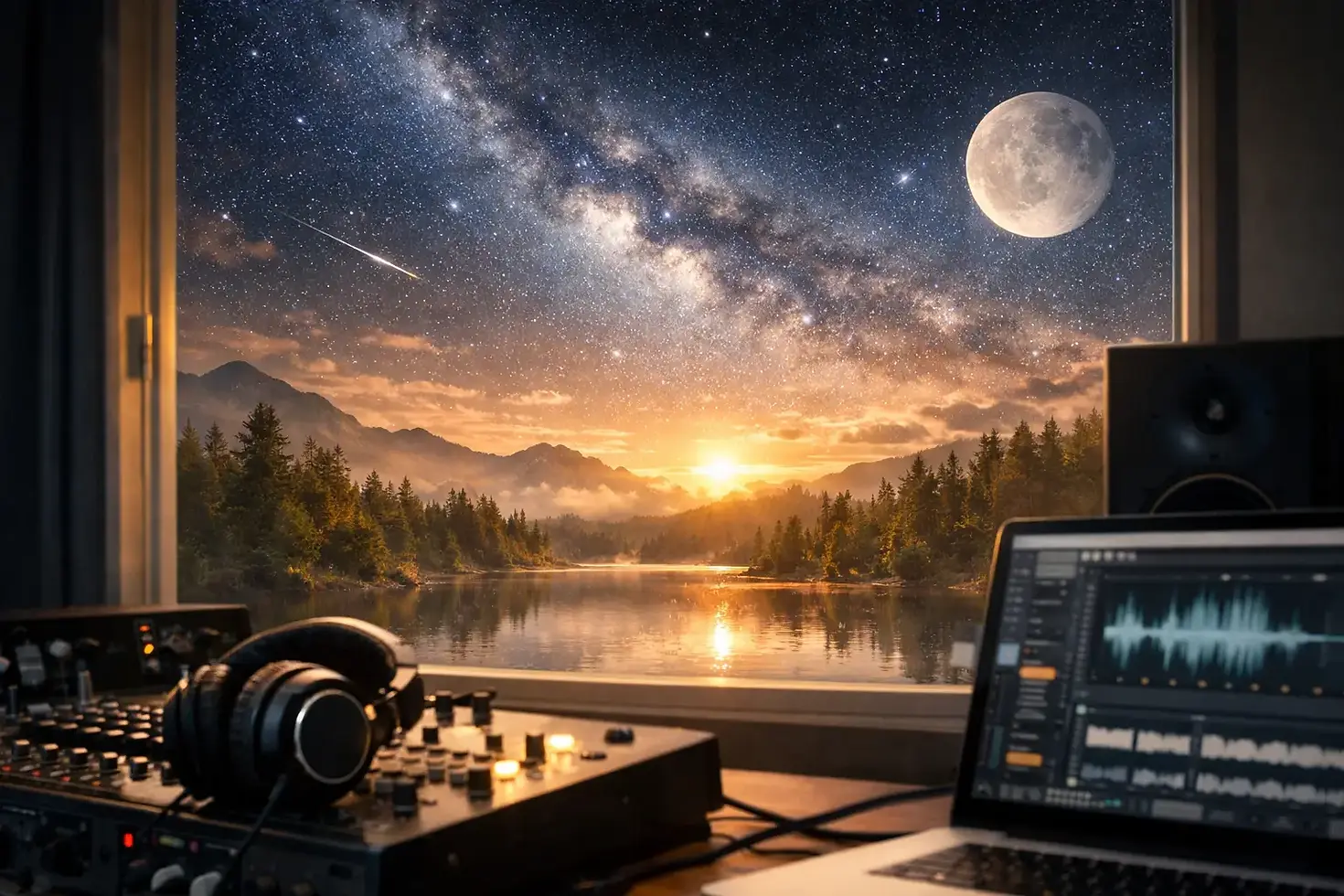
Soundtrack Trends: Why Atmosphere Is Leading
A single sustained piano note can now carry more meaning than an entire orchestral statement. Among the most revealing soundtrack trends is a renewed trust in atmosphere: music that does not explain every feeling, but gives the listener room to enter it. Across film, games, wellness playlists, and independent releases, the score is becoming less concerned with announcing emotion and more attentive to creating a place where emotion can unfold.
This is not a rejection of melody, harmony, or grand cinematic scale. It is a shift in proportion. Listeners are spending more time with music outside the theater or screen, often while working, resting, traveling, or reflecting. A soundtrack no longer ends when the credits roll. It can become part of someone's private landscape.
Soundtrack Trends Are Moving Closer to the Listener
For decades, the popular image of soundtrack music was tied to spectacle: a theme that rises with the hero, a dramatic string passage, a decisive ending. That language remains powerful when a story calls for it. Yet many contemporary scores are built from quieter materials - a restrained piano figure, distant synths, bowed textures, field recordings, low-frequency pulses, and silence used with intention.
The reason is partly narrative. Modern visual storytelling often lives in ambiguity. Characters are not always certain of what they feel, and audiences are not always meant to receive a clear emotional instruction. Music can honor that uncertainty. Rather than pushing a scene toward sadness or triumph, it can hold tension between the two.
The same change is happening in games. A fixed, linear score can feel disconnected from a player who is wandering, waiting, or choosing a different path. Adaptive music, built in layers and variations, responds to time and movement. Its success is often measured not by how loudly it demands attention, but by how naturally it makes a world feel inhabited.
For composers, this creates a different question: not simply, "What should the audience feel here?" but "What kind of space should this scene leave behind?" The answer may be a melody. It may also be an unfinished phrase, a fragile texture, or a harmonic color that lingers without resolving.
Intimacy Has Become a Cinematic Language
One of the clearest soundtrack trends is the preference for sounds that feel physically close. The soft impact of a piano key, the breath before a vocal phrase, the grain of a cello bow, and the slight instability of tape or analog processing can create a sense of presence that polished perfection sometimes removes.
This intimacy is not merely an aesthetic fashion. It reflects the scale at which many people listen. Headphones have become a primary listening environment, and they reveal small details with unusual clarity. A score can now speak almost privately, as if it were composed for one person walking through a late evening rather than for a room full of people.
There is a trade-off. Close, delicate production can lose force in a large theater or beneath dense dialogue and sound design. A composer working for picture must still think about frequency range, pacing, and the practical life of a cue. The most effective intimate scores are not simply quiet. They are carefully shaped so that every small gesture remains legible.
That care also matters for instrumental music released beyond a screen. When a listener returns to a piece during a difficult morning, a long train ride, or an hour of concentration, detail becomes part of the relationship. The music does not need to insist. It needs to remain honest over repeated listens.
Texture Is Carrying More of the Story
Melody is still central to memorable soundtrack writing, but texture increasingly performs narrative work once given only to themes. A low electronic drone can imply distance. A blurred piano can suggest memory. A pulse that never quite settles can make an empty room feel charged with possibility.
Textural writing is especially useful when language would make a scene too literal. It allows a score to approach emotions that are hard to name: anticipation without a clear object, grief before it becomes conscious, peace with a trace of unease. These are not minor feelings. They are often the emotional truth of a story.
Technology has expanded the palette, but more options do not automatically lead to more depth. Layering every available sound can flatten a piece into atmosphere without direction. Restraint is what gives texture its meaning. One carefully chosen sound, placed at the right moment, may say more than ten tracks competing for attention.
The Return of Silence and Space
Silence is becoming more visible in the language of contemporary scoring. Not total silence in every case, but a willingness to let a cue breathe. This can mean leaving room between piano notes, allowing reverb to decay naturally, or ending before the listener expects a final statement.
Space changes the listener's role. When music leaves something unresolved, the audience participates by bringing its own memories and associations into the gap. That is why a minimal score can feel deeply personal without telling a listener what to think.
For visual media, the decision to use less music requires confidence. A scene may need room tone, dialogue, or a single natural sound rather than another emotional layer. For independent composers, the equivalent question is whether a track needs another section, another instrument, or a more dramatic ending. Sometimes it does. Sometimes the stronger choice is to preserve the stillness that gave the piece its identity.
Music Designed for More Than One Context
Soundtrack-inspired music now lives across several listening habits. A composition may begin as a cinematic idea, then accompany a reader, a designer at work, someone meditating, or a listener looking for a moment of calm. This does not mean music should be reduced to a productivity tool. It means its afterlife has become more expansive.
The strongest pieces can serve different contexts without becoming anonymous. They retain a distinct point of view: a particular harmonic language, a recognizable use of space, or an emotional pace that belongs to the composer. Background listening is not lesser listening. It can be an intimate form of companionship, especially when the music has enough character to reward attention whenever the listener returns.
This is where independent artists have a meaningful advantage. They are not required to write toward a single market expectation. An album can move slowly, return to a motif, or build a world across several pieces. The work can be guided by atmosphere and emotional continuity rather than by the demand for an immediate peak.
At Alex Lunati Official, that perspective is central to instrumental writing: music can be purposeful without becoming prescriptive. A composition may suggest a scene, but it should also remain open enough for the listener's own inner images.
What Will Endure Beyond the Current Moment
Trends can identify a direction, but they should not become a formula. Soft piano, ambient pads, and intimate recording techniques are not meaningful by themselves. When repeated without a clear reason, they become decorative. The lasting work will come from composers who understand what each sound is doing emotionally and structurally.
There will always be room for bold themes, full orchestras, rhythmic momentum, and music that fills a frame with light. The more interesting development is that these choices can now coexist with fragility. A score may move from near-silence to scale without losing its center, provided the emotional arc earns that movement.
For listeners, the value of these soundtrack trends is not simply a new sound. It is the possibility of music that stays close without crowding the mind. The next piece worth keeping may be the one that leaves a little space for your own story to be heard.


Commenti