


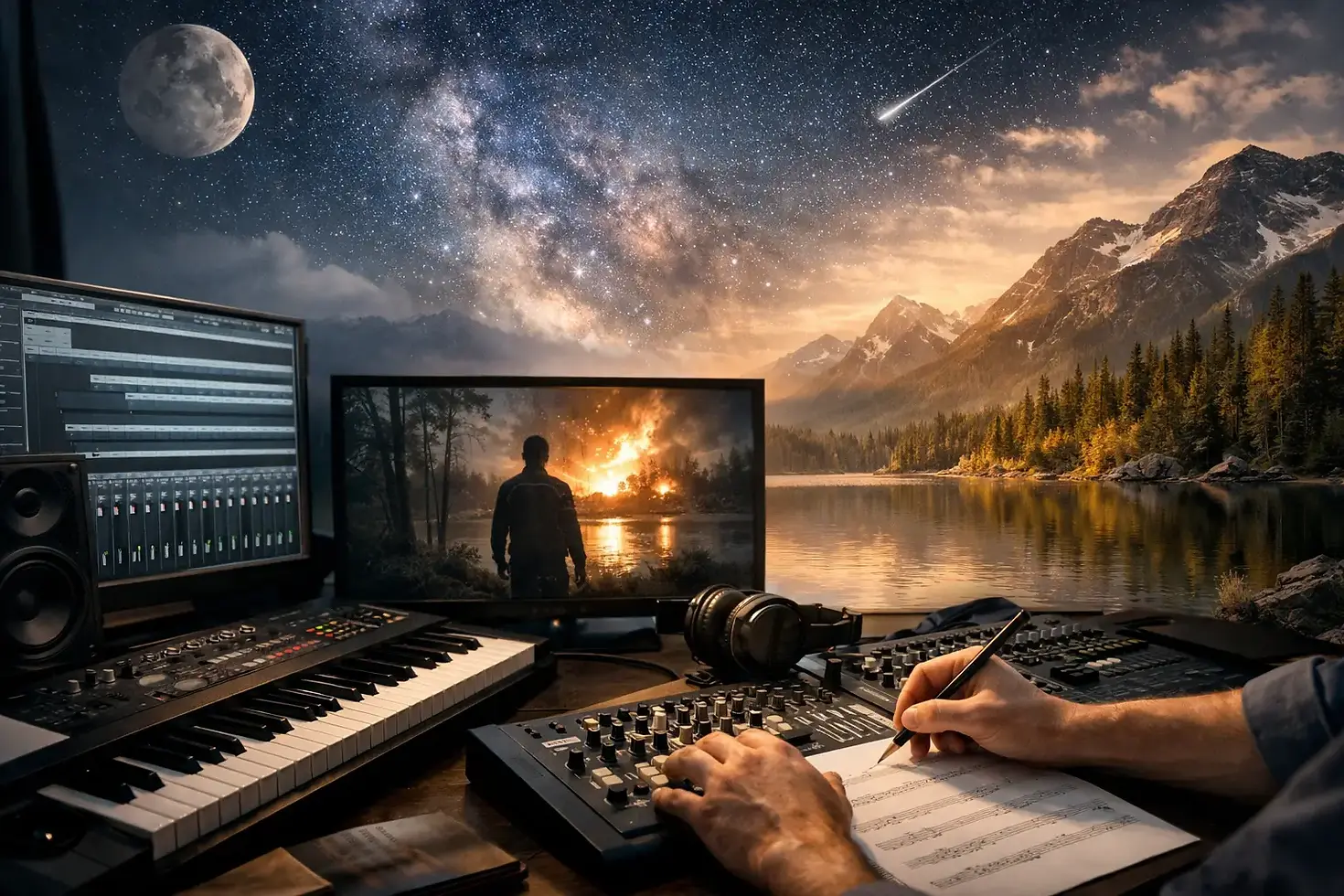
A Soundtrack Composition Example, Scene by Scene
A soundtrack composition example is most revealing when the music is allowed to do more than decorate an image. A scene may show very little on the surface: a person walking home at dusk, a room after an argument, a train disappearing into rain. Yet beneath that visible action, music can suggest memory, hesitation, distance, or the first small movement toward peace.
Consider an imagined scene. A woman stands at the edge of an empty platform after missing the last train. The city is present but far away: wet pavement, a flickering light, the low mechanical hum of tracks. Nothing dramatic happens. She checks her phone, exhales, and sits down. The composition must give this stillness a shape without insisting on what she should feel.
A soundtrack composition example begins with perspective
The first decision is not which instrument to use. It is perspective. Is the score observing the woman from a distance, sharing her isolation, or quietly revealing the hope she cannot yet name? Each approach creates a different relationship between listener and scene.
For this example, the music remains close to her inner world. It begins with a low piano note, soft enough to feel almost accidental, followed by a second note a fifth above. There is space between them. The interval is open rather than resolved, which matters: a major or minor chord would immediately define the emotional color, while two separated tones leave the scene suspended.
A faint field-like texture enters beneath the piano. It is not intended to imitate rain literally. Instead, it carries a grainy, shifting quality that makes the silence feel inhabited. Sound design in a score often works best when it does not announce itself as an effect. Its role is to alter the air around the musical idea.
At this point, the tempo is less important than pulse. There may be no beat at all, only a piano phrase returning every several seconds. This slow recurrence gives the listener something to hold while allowing the image to remain spacious. In soundtrack writing, rhythm can be felt before it is heard.
Building emotion without explaining it
After the woman sits down, the harmony changes almost imperceptibly. A warm sustained synth enters on a note that does not belong neatly to the initial piano shape. The result is a slight friction. It does not signal danger, but it prevents comfort from arriving too soon.
This is where a soundtrack composition differs from a standalone instrumental track in a meaningful way. A self-contained piece can take its time establishing its own landscape. A cue for picture must also respond to timing, gesture, dialogue, and the emotional information already present in the frame. If the actor has shown grief clearly, the score does not need to repeat grief in larger letters. It may be more powerful to offer restraint, numbness, or a memory of warmth.
The piano motif returns, but its final note rises by step. It is a small alteration, almost too subtle to notice on a first listen. Still, it changes the direction of the phrase. What had seemed like a closed circle now has an opening.
That opening is the emotional center of the cue. Not optimism in a conventional sense, and not a cue that tells the audience everything will work out. It is simply the recognition that the woman is still present within the quiet, still capable of moving forward. Instrumental music can hold this kind of ambiguity with unusual grace because it does not have to define the feeling in words.
Why fewer notes can carry more weight
In an intimate scene, the temptation is to add detail whenever the image feels empty. More strings, a deeper bass, a more elaborate melody. Sometimes that works. Often it turns a private moment into a performance.
Here, the sparseness is part of the composition. The silence after each piano figure is not unused space. It lets the scene breathe and gives the listener room to meet it with personal memory. For contemplative music, this is not a lack of material. It is a form of trust.
The trade-off is clear. Minimal scoring requires confidence in tone, texture, and placement. A crowded arrangement can conceal a weak harmonic idea; a sparse arrangement exposes every note. The sound of the piano, the length of the reverb tail, and the exact moment a pad fades in become structural decisions.
The scene changes, and the score must listen
A bus approaches in the distance. The woman looks up. This is not a climax, but it is a shift in the scene's energy. The composition can acknowledge it by introducing movement rather than volume.
A muted, repeating electronic pulse enters beneath the piano. It is slow and low in the mix, closer to a distant engine than a beat. The motif remains, but its notes are now supported by a gentle progression that moves downward while the melody rises. This contrary motion creates quiet tension: part of the cue is reaching outward, while another part remains weighted by the night.
The bus stops. As the doors open, the sustained synth lifts by one note and the piano stops. The pause is deliberate. In film and visual storytelling, a musical transition does not always need a flourish. A single withheld element can make an ordinary action feel consequential.
Once she steps inside, a different version of the original motif returns on a soft string-like texture. It is not louder. It is wider, with more air around it. The sound suggests a change in environment without pretending the character has been transformed. The platform was exposed and static; the bus is moving, enclosed, and briefly warm.
This approach is especially useful for soundtrack-oriented instrumental work because it lets themes evolve through color as much as melody. A listener may not consciously recognize the motif's return, yet will feel continuity between two emotional spaces.
Harmony, texture, and timing each tell part of the story
A strong cue rarely depends on one element alone. Harmony gives the scene its emotional gravity. Texture determines its physical atmosphere. Timing decides when the music should speak and when it should step back.
In this example, the harmony avoids a full resolution until the final seconds. The cue circles around an implied home chord without landing there. When it finally arrives, the chord is voiced openly, with the third placed high and softly. This keeps the resolution from sounding triumphant. It feels more like a window opening than a destination reached.
Texture carries the weather of the piece. The piano is close and human, with enough natural noise to retain its intimacy. The ambient layer is blurred and distant. The pulse is dry and contained. Their contrast creates depth without requiring a large orchestra or a complex arrangement.
Timing is where composition becomes collaboration with the image. If the pulse begins two seconds too early, it can make the bus feel anticipated rather than discovered. If the final chord lands exactly as the woman smiles, it may become sentimental. Letting the chord arrive as the vehicle pulls away leaves the emotional meaning slightly unresolved, which may be truer to the scene.
What this example reveals about soundtrack writing
The purpose of a score is not always to make a scene more emotional. Sometimes the scene already has enough emotion, and the music gives it contour. It creates a place for attention to rest. It notices the details that dialogue cannot carry: the space after a decision, the ache inside a familiar room, the calm that follows exhaustion.
There is no single correct palette for this kind of moment. A solo cello could replace the piano. A washed-out guitar could make the scene feel more intimate or more distant, depending on the recording and processing. A fuller arrangement might suit a larger cinematic frame. The essential question remains the same: what is the image withholding, and what can the music gently bring into view?
For listeners, this is why a short instrumental cue can remain long after the scene has ended. It does not merely recall what happened. It preserves the atmosphere around it. A carefully placed chord, an unfinished phrase, or a silence held one breath longer can become a private space the listener returns to long after the screen goes dark.


Commenti